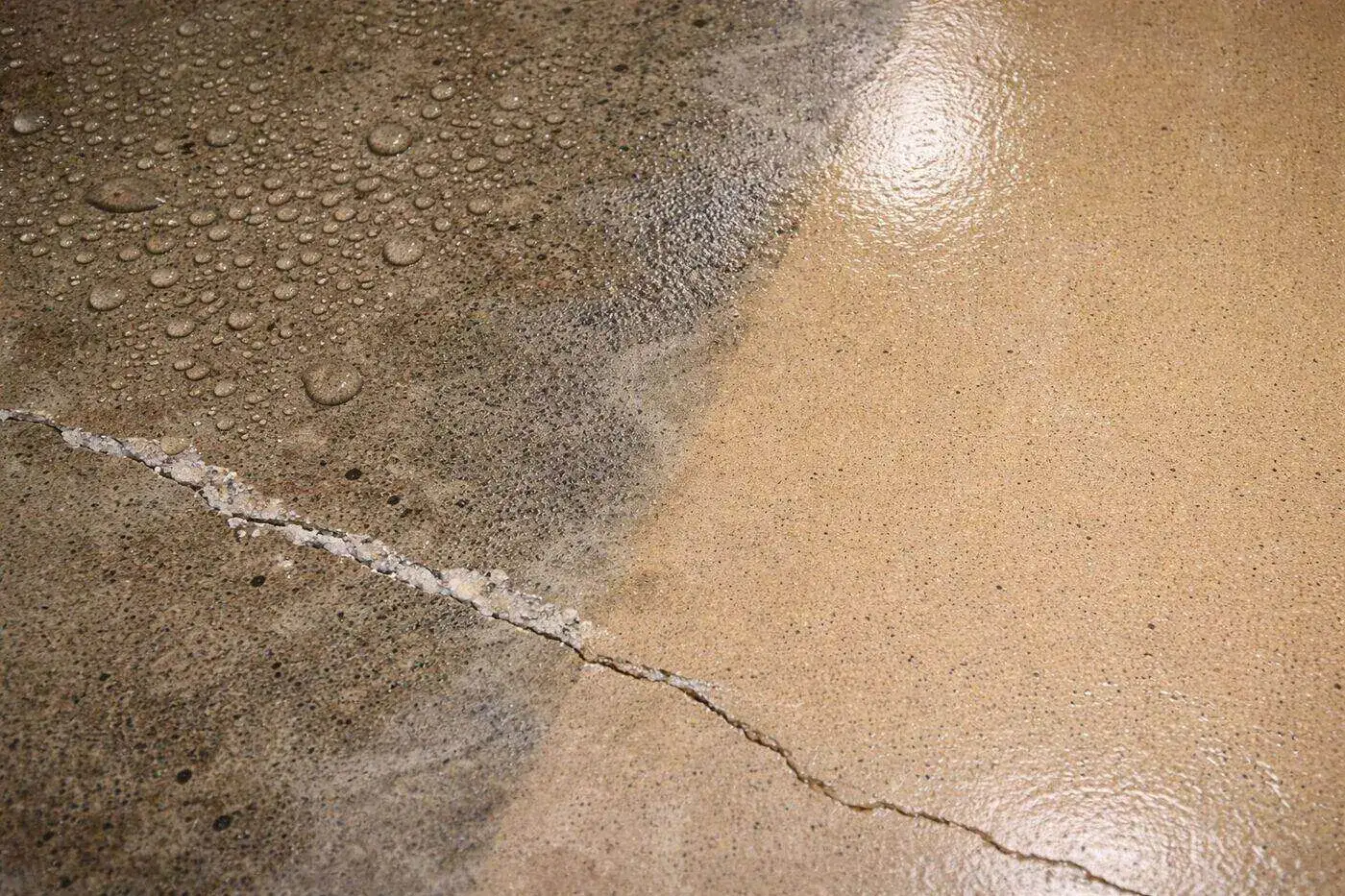
In Collier County, the epoxy itself almost never fails — the slab beneath it does. Coastal estates from the Gulf-front strip of Port Royal to the finger-canal homes of Marco Island and the acreage of Golden Gate Estates all sit on saturated ground, and the moisture rising out of that concrete is what peels a brand-new floor. The cure is not a better resin. It is a moisture reading taken before the first coat ever goes down.
Picture a homeowner in a waterfront neighborhood off Naples Bay, or on one of the finger canals threading through Aqualane Shores and the Isles of Capri near Marco Island. They invest in a glossy garage floor during the dry winter, and by the time the summer storms arrive, the surface is bubbling and lifting in sheets. The reflex is to blame the crew or the brand. But the damage was set in motion before anyone opened a bucket — by water the eye could never see. In a county this close to sea level, that scenario is common enough to deserve its own playbook. Below, we walk through why Naples's geology punishes untested slabs, the standardized checks that catch the trouble early, and the pointed questions that reveal whether the installer in your driveway actually understands Southwest Florida concrete.
What Actually Breaks a Naples Floor
A coating holds because it grips the open pores of the concrete and cures into one continuous skin. That grip depends on a slab that is both dry and stable underneath — and in a low-lying coastal county, neither can be assumed. Groundwater sitting only a few feet down evaporates and migrates upward as vapor, pressing on the back of the film with steady, relentless force. Give it a couple of rainy-season cycles and the bond surrenders: first the cloudy white patches, then the blisters, then whole sections peeling away like old wallpaper.
The trade has a name for this — moisture vapor transmission — and across the coatings industry it ranks as the leading reason new floors fail early. Notice what it is not. It is not a bad batch of resin, and it is not a clumsy roller technique. It is a slab nobody confirmed was ready before the job began. The encouraging part, and the whole reason this guide exists, is that vapor pressure is measurable. A crew that reads the slab first can engineer a system that survives a Naples summer. A crew that skips the reading is rolling dice with your driveway.
Why Naples's Coast and Canals Raise the Stakes
Geology is what makes Collier County one of the toughest places in the country to coat a floor correctly. The whole region rests on porous, water-bearing limestone, and the county itself is a wide, flat shelf rarely more than a handful of feet above sea level. Trace it on a map: the beachfront strip from Marco Island up through Pelican Bay, the dense grid of navigable canals in Naples and Lely Resort, the lakeside subdivisions of Vineyards and East Naples, all the way west to where the suburbs press against the Everglades. Across nearly all of it, the water table is a near-constant presence just below your foundation, feeding vapor up through the slab around the clock.
Living on or near the water magnifies the effect. Homes on a canal or a few blocks off the Gulf sit on some of the most saturated ground in the county, and salt-laden coastal air off the Gulf of Mexico keeps the surrounding humidity stubbornly high, so the concrete rarely gets a real chance to dry out. The way Southwest Florida builds doesn't help either: countless slabs were poured straight on grade with a thin or aged vapor barrier beneath, and on older homes that barrier may have failed entirely. High water table pushing up, little or nothing holding it back — that is the Naples default, which is exactly why moisture mitigation is a routine line item here rather than the rare exception it would be in a dry inland city.
And this is not a theoretical worry dragged in to sell an upgrade. Slab testing in saturated Southwest Florida soils routinely returns readings well above the safe vapor threshold — sometimes high enough that the concrete has to be ground open and sealed with a vapor-barrier primer before any topcoat can be trusted to stay put. To the naked eye the floor looked bone-dry. The meter told the truth.
The 75% Line Naples Slabs Fight to Cross
Concrete is far more porous than it appears, and it stores internal moisture you will never see at the surface. The benchmark the coatings industry relies on is internal relative humidity — the dampness measured deep inside the slab, not skin-deep on top. Epoxy needs that figure below roughly 75 percent to form a dependable bond. Push past that line and the odds of failure climb fast.
Few places make 75 percent harder to reach than Naples. Year-round the outdoor air hovers around three-quarters saturated, the county collects well over 60 inches of rain a year, and the storm-heavy stretch from June through October dumps daily downpours that keep the ground table topped off and slabs damp from below. There is a curing hazard on top of the bonding one: when humidity is high as the coating goes down, epoxy can develop amine blush — a cloudy, greasy film signaling the resin did not cure cleanly and will not adhere as it should. On a humid Naples afternoon, which is most of them, that risk is very real.
This is why a capable Naples installer never relies on a glance at the sky. They read the slab's internal moisture, inspect the surface, and time the pour around conditions the concrete can genuinely handle. Lay a coating over a slab still sitting above 75 percent relative humidity and you have, in effect, scheduled its failure in advance.
Worried About Moisture in Your Slab?
We test before we quote. Get a straight answer about your concrete and a system built to hold in Southwest Florida.
The Moisture Tests That Catch the Problem
None of this requires guesswork. The construction industry settled long ago on standardized tests that quantify exactly how much moisture a slab is moving, and any installer worth hiring in Naples should be running at least one before quoting your job. Three are worth knowing by name.
Relative Humidity Probe Test (ASTM F2170)
Treat this as the gold standard. The crew drills small holes into the slab, seats sealed probes, and reads the relative humidity deep inside the concrete rather than just where the resin would sit. Because it captures the very moisture that drives coatings off the floor, ASTM F2170 is the number most manufacturers cite when they set the conditions on their warranty. Come in under roughly 75 percent and your slab is in the safe zone to coat. Read higher, and mitigation has to come first — a result that, on Naples's saturated coastal ground, is anything but rare.
Calcium Chloride Test (ASTM F1869)
An older but still useful approach, this one gauges how much moisture escapes the slab surface over a set window, expressed as pounds per 1,000 square feet across 24 hours. For most coatings the accepted ceiling is 3 pounds; climb above it and vapor pressure is strong enough that delamination risk jumps and a vapor barrier becomes non-negotiable. It remains a solid check, though the RH probe has largely overtaken it as the benchmark precisely because it reads what is happening inside the slab, not merely at the top.
Plastic Sheet Test (ASTM D4263)
This is the fast field screen. The installer tapes a square of clear plastic flat against the slab and leaves it a day or more. If condensation beads underneath or the concrete darkens beneath the sheet, moisture is on the move. Handy for flagging an obvious problem, but it is a yes-or-no indicator, not a substitute for the measured tests above. A floor you are paying real money for deserves a number, not a plastic square.
| Test | What It Measures | Safe Range |
|---|---|---|
| RH Probe (ASTM F2170) | Internal slab humidity | Below ~75% RH |
| Calcium Chloride (ASTM F1869) | Surface moisture emission | Under 3 lbs / 1,000 sq ft / 24 hrs |
| Plastic Sheet (ASTM D4263) | Visible moisture (screening) | No condensation under sheet |
A High Reading Isn't a Dead End — It's a Spec
A heavy moisture number does not disqualify your floor. It simply changes the build. The answer is a moisture-mitigation primer — sometimes called a vapor-barrier coat. The slab is mechanically ground first to open the surface and give the primer something to bite into, then a specialized epoxy primer engineered to tolerate and arrest vapor is rolled across it. That primer seals the concrete and lays down a barrier the decorative system can finally bond to without the moisture below ever reaching it.
Yes, the step costs money — figure roughly $1.50 to $3.00 per square foot on top of the base price, plus the test itself, which generally runs $200 to $400 (and is often credited or included free when you book the work). But framing it as an upsell misreads what it does. On a saturated Naples slab, mitigation is the line between a floor that holds for years and one that lifts before the next hurricane season. The clearest way to see it: the primer is not making your floor pricier, it is making your floor possible.
It is also the reason a trustworthy local crew tests before quoting instead of after. Skip the reading and every number on the estimate is a guess — and the suspiciously cheap guesses are almost always the ones that quietly left mitigation out. When you line up bids, the quote that runs a little higher because it includes the test and the right primer is, in this climate, nearly always the cheaper floor measured over its life.
What to Ask Before You Hire a Contractor
You do not have to turn into a concrete chemist to protect yourself. You only have to ask a handful of pointed questions and notice whether the answers are specific or evasive. Run any installer through this list before you sign anything.
- Will you test my slab for moisture before you quote it? The answer you want is yes, with a named method — an ASTM F2170 relative humidity probe or an ASTM F1869 calcium chloride test. If they brush the question aside, keep dialing.
- What reading is too high to coat without mitigation? Someone who knows Naples concrete will cite the roughly 75 percent RH threshold or the 3-pound calcium chloride limit without hesitating. A blank look is your cue to move on.
- If my slab comes back wet, what is your plan? You want to hear a diamond grind plus a moisture-mitigation or vapor-barrier primer — not a shrug and a "it'll probably be fine."
- How exactly will you prep the concrete? The right answer is a diamond grind that opens the surface for a true mechanical bond. An acid wash or a quick scuff does not cut it on a coastal slab.
- What topcoat do you use, and is it UV-stable? Our sun ambers coatings that aren't built for it, and waterfront homes catch glare off the canal on top of that. A polyaspartic or polyurea topcoat stands up to both the humidity and the light.
- What does your warranty cover, and what voids it? A written warranty that holds up under normal use tells you the crew stands behind its prep. Read the fine print on what cancels it.
An installer who fields these cleanly is telling you, in plain terms, that they understand the Southwest Florida slab under your garage. That understanding — far more than the resin brand or the price per square foot — is what decides whether your floor still looks flawless five rainy seasons from now. For the money side of the equation, our companion guide on how much epoxy flooring costs in Collier County breaks down every finish and the local cost drivers, moisture mitigation included.
Frequently Asked Questions
Why do epoxy floors fail in Collier County?
In Naples, the coating rarely fails on its own merits. It fails because moisture vapor pushes up through a slab sitting just above the water table and breaks the bond from below, leaving bubbles, blisters, and peeling. The county's coastal, sea-level ground and salt-air humidity make this far more common here than in any dry inland city. The cure is to read the concrete's moisture before a single coat goes down.
What is moisture vapor transmission and why does it matter?
Moisture vapor transmission is groundwater beneath the slab evaporating and rising as vapor through the porous concrete. That vapor presses on the underside of the epoxy with real, steady force and, over weeks of Naples's wet-season humidity, works the film loose. It is the leading cause of early coating failure here, and it is fully preventable because it can be measured before the work starts.
What moisture tests should a Collier County epoxy installer run?
Three standardized tests cover it: the relative humidity probe (ASTM F2170), which reads moisture deep inside the slab and should sit below about 75 percent; the calcium chloride test (ASTM F1869), which should stay under 3 pounds per 1,000 square feet over 24 hours; and the plastic sheet test (ASTM D4263), a quick yes-or-no screen. On Naples's saturated coastal slabs the RH probe is the one to insist on, because it measures conditions inside the concrete rather than just at the surface.
How much does moisture mitigation add to an epoxy floor?
A moisture-mitigation or vapor-barrier primer generally adds about $1.50 to $3.00 per square foot on top of the base price, plus the moisture test itself, which usually runs $200 to $400 and is often credited toward the job. On a large share of Naples slabs it is not an add-on at all — it is simply part of installing the floor correctly the first time.
Can a wet slab still be coated with epoxy?
Yes. A high reading on a coastal Naples slab does not rule out an epoxy floor; it changes the prep. The concrete is mechanically diamond-ground, then a specialized moisture-mitigation primer is applied that blocks the rising vapor and lays down a barrier the decorative coating can bond to safely above it.
What should I ask a contractor before hiring them in Collier County?
Ask whether they test your slab for moisture before quoting, what reading is too high to coat without mitigation, what they do if it comes back wet, how they prep the concrete (the answer should be a diamond grind), what topcoat they use and whether it is UV-stable, and what their written warranty covers and what voids it. Crisp, specific answers signal an installer who actually understands a Southwest Florida coastal slab.
Read the Slab, Then Coat It Once
Naples's heat, salt air, and sea-level water table are not arguments against an epoxy floor — they are arguments for doing one properly. A slab that has been tested, ground correctly, mitigated where the meter demands it, and capped with a humidity-tolerant, UV-stable topcoat will outlast and outperform nearly any other garage or commercial surface, coastal climate and all. The peeling-floor horror stories you hear around the neighborhood are not the technology breaking down. They are a corner cut on the single step that matters most.
At Ascent Epoxy Naples, every project opens with an honest look at your concrete and a moisture reading before we ever name a price. We spec the system your slab genuinely needs, not the cheapest one that fits on a flyer. Call (239) 323-9216 or request a free quote online to get your slab evaluated. We serve Naples, Marco Island, Pelican Bay, Golden Gate, North Naples, Naples Park, Lely Resort, Vineyards, East Naples, and communities across Collier County.